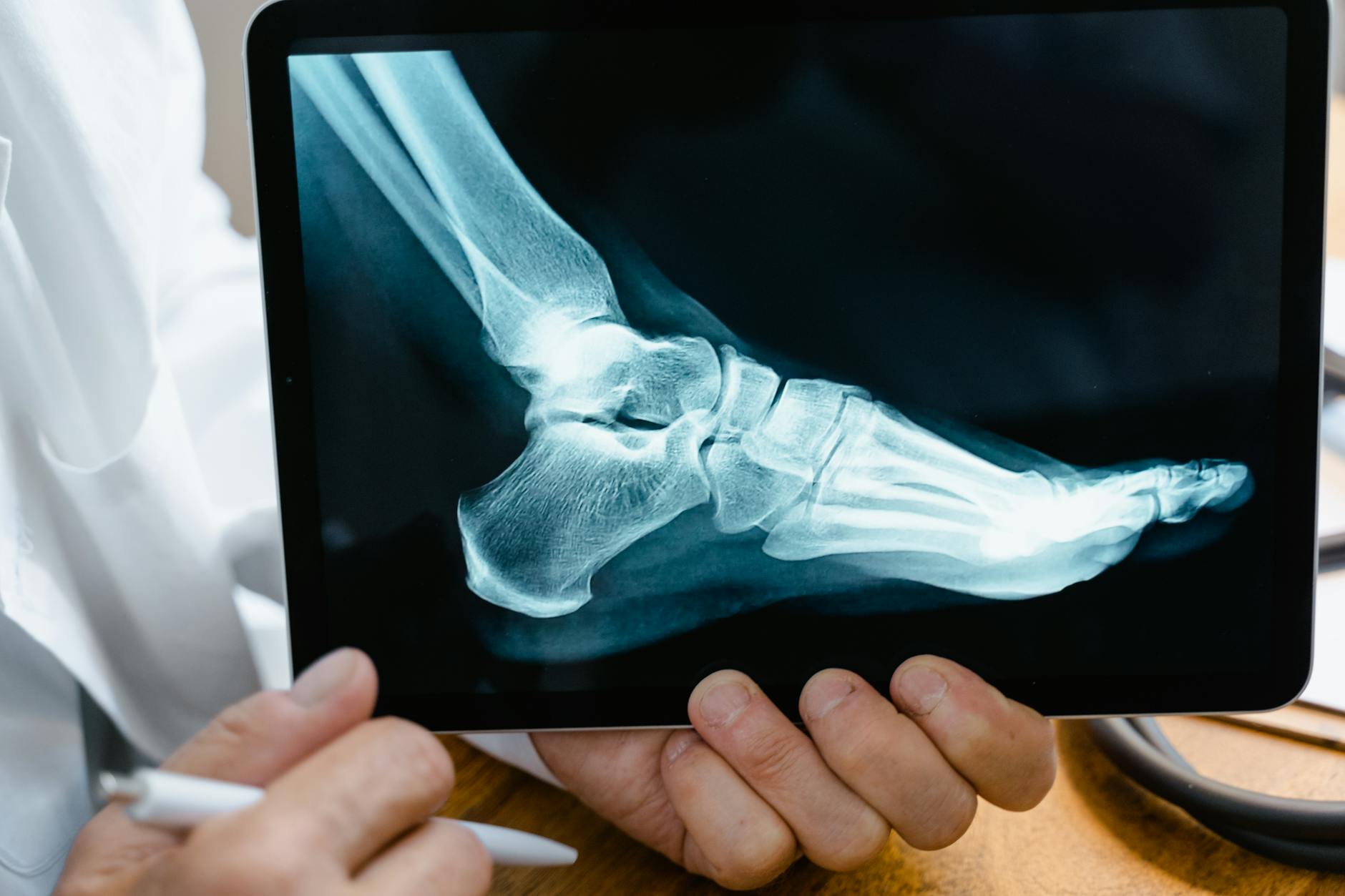
I watch people walk down the hallway toward exam room three long before I ever look at their charts. You can hear the heavy, uneven slapping sound of a collapsed arch hitting linoleum from twenty feet away.
1. The Tell is Always in the Heel Strike
I knew what was wrong with the young runner sitting on my table before she even took off her shoes. The medial side of her left sneaker was crushed inward like a stepped-on soda can. Overpronation doesn’t start when your foot rests flat on the ground. It begins in the split second your heel decides how to absorb your body weight.
2. Your Knee is Just the Messenger
Most articles will tell you overpronation is a foot condition. That framing misses the point entirely. The foot is just the anchor on the floor, but the knee is the hinge taking all the rotational abuse from that poor anchoring. When your arch collapses inward during a stride, your tibia has absolutely no choice but to rotate internally to compensate for the shifted weight. Your femur naturally follows suit, which drags your kneecap violently out of its smooth cartilaginous track. People come in complaining of patellofemoral pain, rubbing their knees and asking for cortisone injections so they can keep running. I have to explain that treating their knee is like mopping the floor while the sink is still overflowing. (It is a hard sell when someone is hurting). We end up looking at their foot mechanics, because the knee is simply the victim of a lazy arch. What happens in the exam room rarely matches the textbook diagrams showing perfect right angles and isolated joints operating independently. In reality, the body is a sloppy, interconnected web of pulleys and levers. Fix the base and the hinge stops grinding against itself. If you just brace the knee, the rotational force simply travels further up to the hip joint. You cannot cheat physics.
3. What the General Practitioner Misses
Primary care doctors usually tell patients they just have flat feet and suggest buying gel inserts off a pharmacy rack. At the specialist level, we look at the dynamic load instead of the static resting posture. Flat feet are static. Overpronation is an active, destructive movement pattern. A GP might check for basic tenderness, but they rarely ask you to do a single-leg squat barefoot in the office. If you try that with severe overpronation, your knee dives straight toward your opposite leg. That inward collapse is what actually tears meniscus tissue over time.
4. The Deceptive Comfort of Cushioning
“I bought the thickest, squishiest running shoes I could find and my shins actually hurt worse.” She was frustrated, staring at her expensive foam-soled sneakers on the floor. I hear this exact complaint weekly. Maximalist shoes feel great standing still. But when you overpronate, putting two inches of soft foam under a rolling foot just gives it more room to collapse. You are basically asking a leaning building to stabilize itself on a mattress. You need density, not pillows. Firm medial posting blocks that inward roll before it strains the ligaments.
5. The Upward Pelvic Cascade
The chain reaction doesn’t stop at the knee joint. When both feet roll inward excessively, the pelvis tilts forward to maintain your center of gravity. We see this mechanical shift constantly in older patients struggling with chronic lower back tightness. According to a 2017 observational cohort in the Journal of Physical Therapy Science, foot hyperpronation directly increases lumbar lordosis and thoracic kyphosis. Your spine curves aggressively just to keep you from falling on your face.
6. Starving the Achilles Tendon
Why do overpronators get so much Achilles tendinopathy? The twisted mechanical load actually acts like a kinked garden hose. A Clinical Biomechanics analysis from 2016 demonstrated that this inward rolling severely restricts blood flow at the mid-tendon. You aren’t just stretching the tendon poorly. You are suffocating its blood supply right where it needs to heal.
7. The Illusion of Arch Strengthening
Can you actually rebuild a collapsed arch with toe curls and marble pickups? No. You can strengthen the intrinsic muscles around it, but once the spring ligament stretches out completely, it stays stretched. I see patients wasting months on generic physical therapy exercises trying to reverse structural genetics. The arch is a suspension bridge. If the main cables snap, strengthening the road surface won’t hold the bridge up. We focus on controlling the descent rather than pretending we can magically rebuild the arch.
8. Calluses Tell the True Story
“It feels like I have a rock permanently glued under my big toe.” The guy was a fifty-year-old mail carrier. He sat there rubbing the medial side of his foot, right at the base of the first metatarsal. I didn’t need an X-ray to know what was happening beneath the skin. When your foot overpronates, you stop pushing off evenly across your toes during the terminal stance of your gait cycle. All your body weight suddenly transfers to the inside edge of that big toe joint with every single step you take. The skin responds to that massive, repetitive friction by building a thick, painful callus to protect the bone beneath. Podiatrists call it a pinch callus. You can shave it down with a scalpel every month in the clinic, but it will always come back until you change the biomechanics of the stride itself. We still don’t completely understand why some people tolerate this massive medial loading for decades without joint deterioration while others develop severe arthritis in their twenties. The human body adapts to poor mechanics in wildly unpredictable ways. Some people get a rigid deformity, while others just get superficial skin pain that drives them crazy enough to finally seek help.
9. The Posterior Tibial Tendon Gives Up
This is the muscle trying desperately to hold your arch up against gravity.
When it finally fails, the pain is sharp, sudden, and localized just below the inside of your ankle bone. The tendon simply frays from fighting a losing battle against your own body weight.
10. The Structural Endgame
Eventually, the bones themselves adapt to the terrible angles. The heel bone tilts outward permanently. The midfoot sags into the floor. Older adults with untreated severe pronation inevitably develop rigid, arthritic joints that no longer fit into standard footwear. They walk with a wide, shuffling gait because the mechanical advantage of their foot lever is entirely gone. The joint spaces narrow, bone grinds on raw bone, and the deformity becomes fixed.
Biomechanics dictate everything from how your skin calluses to how your spine curves. Ignoring a collapsing arch guarantees the rest of the skeletal chain will eventually pay the toll.
Medical Disclaimer: This article is for informational purposes only and does not constitute professional medical advice. Always consult a qualified healthcare professional before making changes to your health routine.




