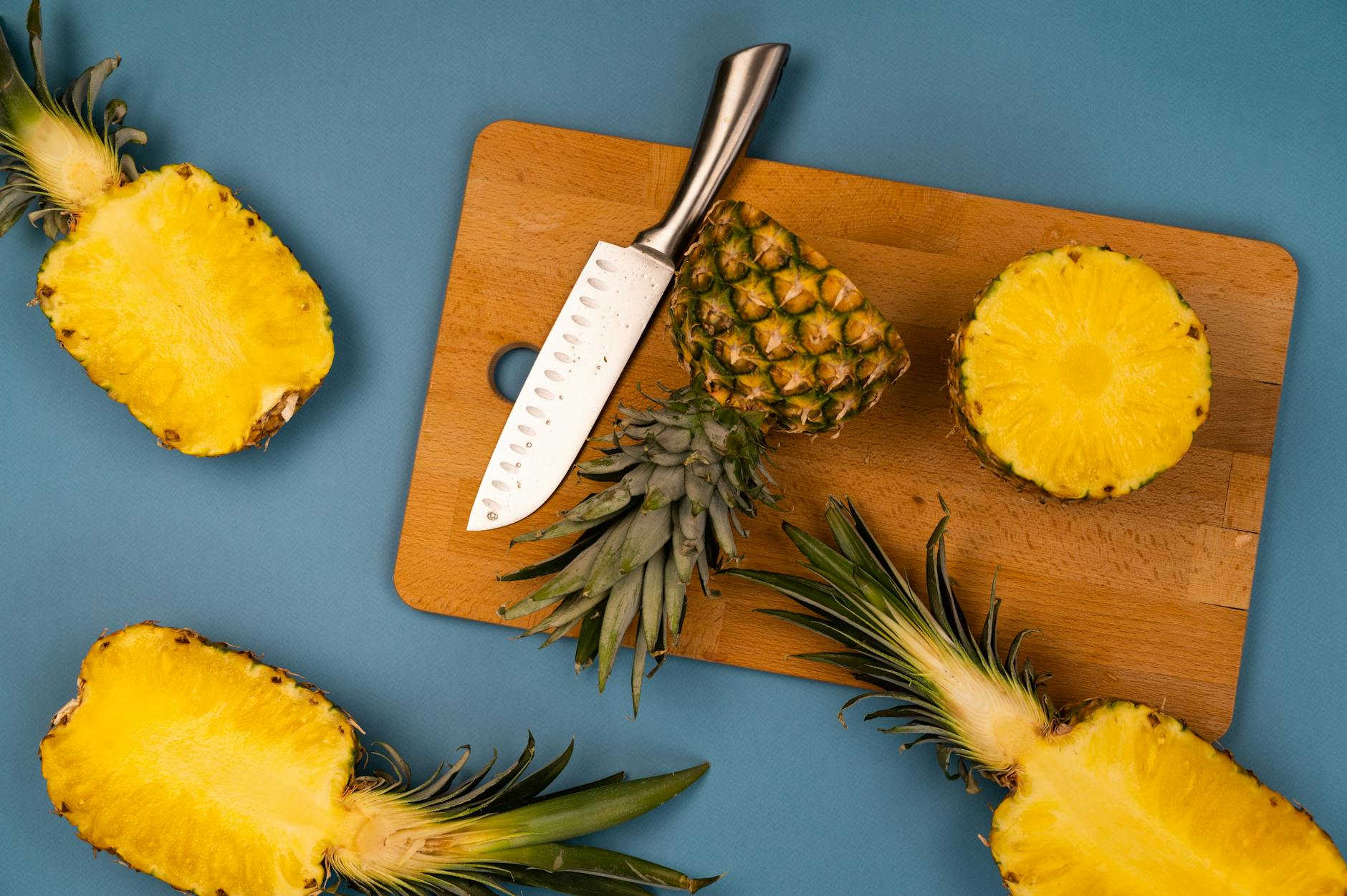
I spend every summer suturing the flexor tendons of people who underestimated the structural integrity of a tropical fruit. You buy a whole pineapple thinking about fresh juice, grab a dull eight-inch chef’s knife, and end up in my trauma bay holding a blood-soaked kitchen towel.
1. The Geometry of Slicing Wounds
A cylinder with an armored exterior resists uniform downward pressure. You push harder. The blade deflects laterally into your non-dominant index finger. I see this exact injury pattern three times a week from June to August. A sharp blade grabs the rind, while a dull edge skates off the surface directly toward your hand.
2. Proteolytic Enzymes Digesting Your Tongue
People assume the stinging sensation comes from acidity. Most articles will tell you it’s just a mild irritant. That framing misses the point entirely. You’re experiencing an active biological degradation of your mucosal lining. Pineapple contains bromelain, a complex proteolytic enzyme mixture that aggressively breaks down amino acid chains. When you chew the raw flesh, it literally digests the surface cells of your tongue and buccal mucosa. “My mouth feels like it’s full of crushed glass.” A young mother told me that last Tuesday in exam room four. She was terrified she was experiencing sudden anaphylaxis from a fruit salad. But her airway was pristine. Her lips were just mildly edematous from localized enzymatic trauma. You can easily denature the protein by roasting or grilling the wedges. Most folks just power through the burning until their palate actually bleeds. The exact mechanism of how bromelain selectively targets the superficial epithelial layers without penetrating deeper vascular tissue is not fully understood yet. We just know the destruction eventually stalls when your endogenous salivary proteins neutralize the reaction (usually within a few hours of stopping consumption). You’re chewing on something that’s simultaneously digesting your face. And the more you eat, the less tissue you have left to defend the underlying nerves.
3. The Rind Acts Like Fiberglass
Holding the exterior bare-handed causes mechanical micro-abrasions. The rigid spikes create microscopic tears in your palm. Plant juices then seep into those fresh wounds. I can spot this presentation the second a patient takes off their gloves. Before we even run a patch test, I see the faint, cross-hatched erythema on the palmar surface of their non-dominant hand. The redness perfectly mirrors the grip pattern used to stabilize the fruit on a cutting board. You wash your hands, thinking the itching will stop. It rarely does. The inflammatory response has already cascaded into the dermis.
4. Misdiagnosing the Oral Allergy
Primary care doctors frequently mislabel pineapple reactions. A patient complains of an itchy throat. The GP writes down an allergy diagnosis and prescribes an EpiPen. They miss the nuance of Oral Allergy Syndrome entirely. The proteins in raw pineapple structurally resemble birch pollen. Your immune system gets confused and mounts a localized defense. An allergist recognizes this cross-reactivity instantly. The patient doesn’t need a lifetime ban from the fruit. They simply need to avoid it during peak pollen seasons when their histamine baseline is already elevated.
5. The Fructose Delivery Rate
Removing the fibrous core changes the metabolic math. The core holds the dense, insoluble matrix that slows gastric emptying. You discard it because it requires too much chewing. Doing so converts the remaining flesh into a rapid-acting sugar bomb. Your pancreas responds to the sudden glycemic load with a massive insulin dump.
Eat the core if you want stable energy.
6. Flexor Tendons Do Not Forgive
Textbooks describe tendon lacerations as clean, anatomical disruptions with predictable retraction distances. The exam room reality is a jagged, contaminated mess. When a heavy blade slips off a wet pineapple rind, it doesn’t cleanly part the tissue. It crushes and tears the skin before ripping through the sheath of the flexor digitorum profundus. I’ve spent hours under magnification trying to retrieve a retracted tendon that snapped back into a patient’s palm like a broken rubber band. They always tell me the same story. They were trying to slice off the bottom crown to create a flat base. The fruit shifted. The blade dropped. Now they’re facing six weeks in a dynamic splint and months of agonizing physical therapy just to hold a pen again. Do you know why a wet cutting board is so dangerous? The moisture acts as a lubricant beneath the fruit, turning a stable surface into a sheet of ice. Always put a damp paper towel under your cutting board. Never trust the friction of the fruit itself. A simple slip takes three milliseconds and costs ten thousand dollars in surgical fees. Which makes you wonder if saving three dollars by skipping the pre-cut produce section was actually a rational financial decision. The scar tissue binds the gliding mechanism permanently, ensuring your hand never closes exactly the same way again.
7. Tracheal Obstruction from Hasty Prep
People get impatient when cubing the flesh. They leave chunks too large. “He just started turning blue at the island counter.” A frantic husband yelled that to the triage nurse last winter. The slick, wet surface of a poorly chopped pineapple cube bypasses the chewing phase and slides directly into the posterior oropharynx. It lodges against the epiglottis. The fibrous nature of the fruit makes it incredibly difficult to dislodge with standard back blows. The Heimlich maneuver often fails because the chunk conforms tightly to the airway walls. Cut the pieces smaller than a dime.
8. Sphincter Relaxation and Acid Wash
Gastric contents belong in the stomach. High-acid fruits compromise the mechanical barrier designed to keep them there. The lower esophageal sphincter relaxes when bombarded by the unique organic acids found in this tropical plant. You eat a bowl of freshly cut chunks before bed, expecting a light dessert. Two hours later, acidic chyme creeps up into your unprotected esophagus. The pain wakes you from a dead sleep. People stagger into the ER clutching their sternum, convinced their left ventricle is failing. An EKG shows normal sinus rhythm. It’s just the mechanical failure of a valve overwhelmed by fruit acid.
9. The Cutting Board Colony
Cross-contamination destroys more weekends than viral outbreaks. You chop raw chicken on a plastic board. You wash it with hot water and dish soap. You think it’s clean. Then you slice a pineapple on that exact same surface. The acidic juice acts as a perfect solvent, pulling dormant campylobacter out of the microscopic plastic grooves and bathing the raw fruit in it. The porous nature of the flesh absorbs the bacteria instantly. Buy a separate board for produce.
10. Amplifying Antibiotic Absorption
Bromelain alters how your gut absorbs synthetic compounds. If you’re taking amoxicillin for a sinus infection, eating a freshly carved pineapple changes your serum drug levels. The enzyme increases the permeability of your intestinal lining. Your blood concentration of the antibiotic spikes far higher than the pharmacokinetics intended. Nausea follows. Then the diarrhea starts. You blame the pharmacy for a bad batch of pills. The actual culprit is the enzyme altering your mucosal barrier. You manipulated your own drug metabolism without realizing it.
The physical act of breaking down dense fruit introduces variables your kitchen is likely unprepared to handle. Sharpen your chef’s knife before you make the first slice, and respect the biological activity of the flesh you are about to consume.
Medical Disclaimer: This article is for informational purposes only and does not constitute professional medical advice. Always consult a qualified healthcare professional before making changes to your health routine.




